
The forge in the rural economy
Before mechanisation reached Polish agriculture, the blacksmith's forge was as essential to a village as the mill or the well. Every farming community required a continuous supply of iron tools: ploughshares, scythes, sickles, hay forks, harrow tines. These wore out, broke and needed repair or replacement on a seasonal cycle. A forge within walking distance of the fields was not a luxury but a practical necessity.
The kowal also served as the local farrier, fitting and replacing horseshoes for the working animals that powered transport and agriculture. In larger villages, the smithy might be a full-time operation. In smaller settlements, a blacksmith might combine the trade with farming, working the forge during slow agricultural periods and at the request of neighbours throughout the year.
Products of the traditional forge
The range of objects produced in a Polish village smithy covered both functional and decorative categories. On the functional side:
- Agricultural tools — ploughshares, cultivator tines, scythe blades, sickle hooks
- Horseshoes and associated hardware — nails, stirrups, harness fittings
- Carpentry hardware — nails, hinges, hasps, door hardware
- Chains, hooks, rings and fasteners for general farm use
- Wheel rims (tyres) for wooden-spoked wagon wheels
On the architectural and decorative side, the blacksmith produced ironwork for gates, fences, window grilles and well covers. In some regions — particularly the Podhale highlands and parts of Mazovia — this decorative ironwork developed its own regional aesthetic with characteristic ornamental motifs.
Material note: Traditional blacksmithing uses wrought iron or mild steel rather than cast iron. The material is worked hot — typically between 900°C and 1100°C, at which point it becomes plastic and can be shaped by hammer and anvil. Cast iron, by contrast, cannot be worked this way; it is poured into moulds and is brittle when struck cold.
Podhale ironwork: the highland tradition
The Podhale region in southern Poland, centred around Zakopane and the Tatra mountains, developed a particularly distinctive decorative ironwork tradition. Highland blacksmiths produced decorative elements for the timber architecture characteristic of the region — brackets, hinges and gate hardware with scrolled, pierced and repousse ornament. These forms were closely associated with the broader Zakopane Style (Styl Zakopiański), the late nineteenth-century movement that sought to establish a Polish national design vocabulary based on highland folk traditions.
The ironwork vocabulary of Podhale uses a set of recurring motifs: stylised tulips, geometric interlace patterns, spiralling tendrils and heart forms. These appear on cemetery crosses, well covers, decorative gates and the hardware of traditional buildings. Skilled Podhale blacksmiths were able to produce these by combining standard blacksmithing techniques — drawing, upsetting, bending, punching — with detailed finishing work using smaller hammers and hardies.
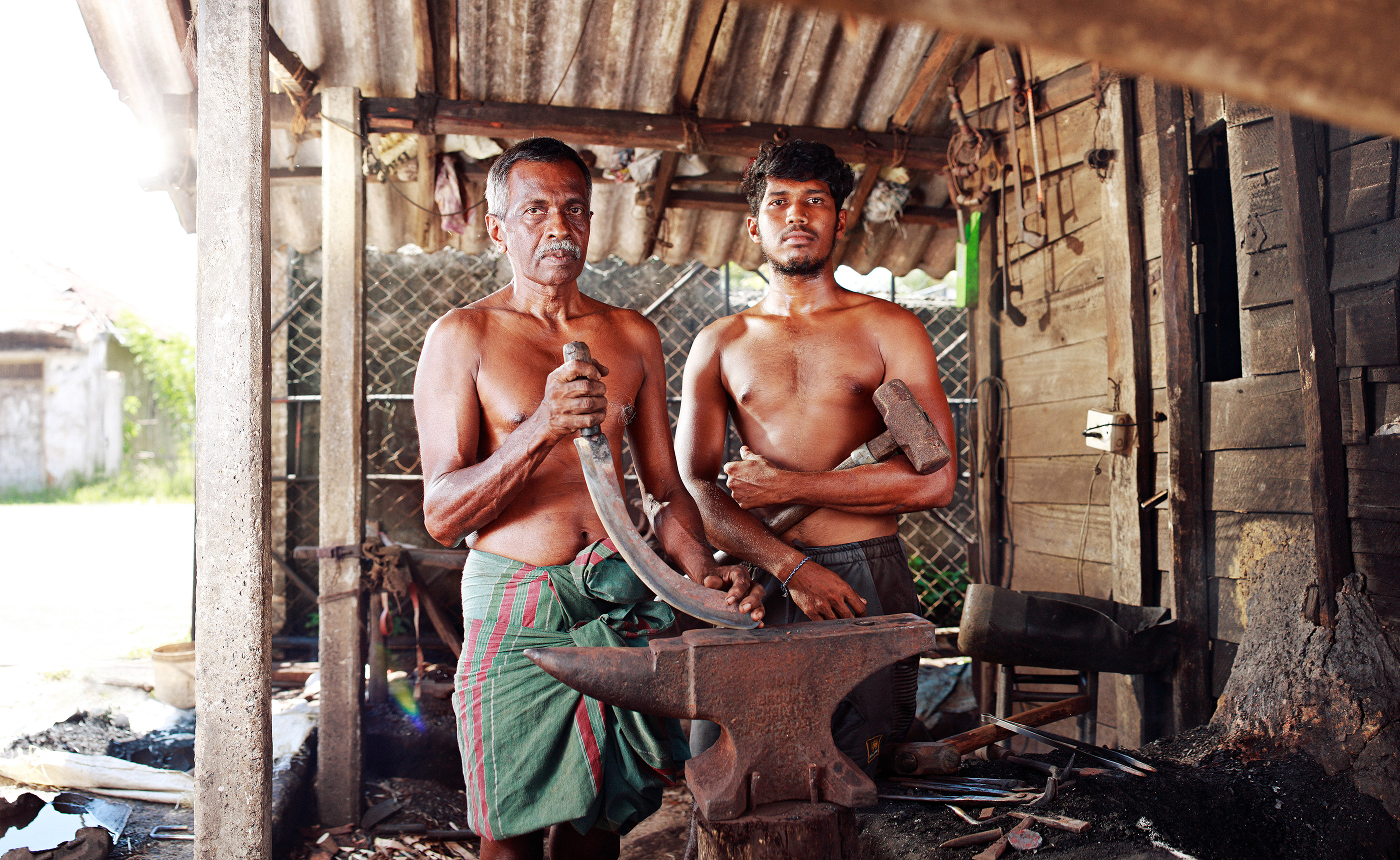
A family forge in operation — the transmission of blacksmithing knowledge through family apprenticeship remained the dominant model for most of the craft's history.
Tools and the working process
The core tools of a traditional Polish smithy changed little over several centuries. The anvil (kowadło) was the central working surface, typically weighing between 100 and 300 kilograms and mounted on a heavy wooden block to absorb hammer impact. The forge itself burned charcoal or later coke, with a bellows or electric blower providing the air supply needed to reach working temperature.
Hammers ranged from the heavy striking hammer used for initial shaping to lighter finishing hammers and specialised cross-peen and straight-peen forms for specific operations. Hardies — cutting and shaping tools that seat in the anvil's hardie hole — expanded the range of operations possible without additional equipment. Swages and fullers were used to create consistent profiles and transitions.
A basic forge operation — say, drawing out a tine for a hay fork — involved heating the bar to orange-yellow, placing it on the anvil, and working it with a series of hammer blows to reduce thickness and extend length, reheating as necessary when the metal cools below working temperature. The process required physical coordination and an accurate reading of the metal's colour as a proxy for temperature.
Family transmission and current practice
Throughout most of its history, blacksmithing knowledge in Poland passed through family apprenticeship. A son or nephew would begin assisting in the forge from childhood, progressing to striker (swingeing the heavy hammer when directed by the smith) and eventually to independent work. Formal guild structures existed in larger towns but were less relevant to village smithing.
The industrialisation of agricultural tool production in the twentieth century removed the functional demand that had sustained most village smithies. Mass-produced tools from regional factories were cheaper and often more consistent than hand-forged alternatives. Many forges closed between the 1950s and 1970s.
What remained were specialist operations: farriers, decorative ironwork producers, and a smaller number of craftspeople focused on artistic and heritage work. These continue to operate across Poland, with concentrations in the Podhale area and in areas with active craft heritage documentation programmes.
Documentation resources
The National Institute for Intangible Cultural Heritage (Narodowy Instytut Dziedzictwa) maintains documentation on traditional craft trades in Poland, including regional ironworking. Regional ethnographic museums — including those in Kraków, Toruń and Wrocław — hold collections of traditional agricultural ironwork and blacksmithing tools that provide reference points for understanding regional variation.

